
Last Updated: November 19, 2026
Quick Summary
A wedding limo arrival should happen 15 to 30 minutes before the first scheduled pickup, giving the chauffeur time to park, check in with the planner, and stage the vehicle at the loading point. Use 20 to 30 minutes for getting-ready locations and ceremony trips, and 30 to 45 minutes for multi-stop photo routes.
- Fifteen minutes is the floor; thirty is the comfortable number for anything with a ceremony deadline attached.
- A buffer not written into the rental block is not a buffer, so ask how the booking clock starts.
- Count rental hours from first pickup to final drop-off, not from the ceremony.
- Send driver instructions in one message at least a week before the wedding.
- The couple should not be the point of contact; assign the role to someone outside the wedding party.
Table of Contents
- How Early Should a Wedding Limo Arrive?
- The Arrival Buffer Rule: 15 to 30 Minutes Before Pickup
- Build a Wedding Transportation Schedule Template That Works
- Factors That Change Your Arrival Buffer
- Understanding Wedding Limo Rental Hours and Booking Lead Time
- Wedding Limo Driver Instructions to Share Before the Day
- Day-Of Coordination: Keeping the Schedule on Track
- Request a Quote and Lock In Your Wedding Limo Timing
- Frequently Asked Questions
How Early Should a Wedding Limo Arrive?
A wedding limo arrival should happen 15 to 30 minutes before the first scheduled pickup. That window gives the chauffeur time to park, check in with the planner, and stage the vehicle at the loading point before anyone steps outside.
The better question is what has to happen in those minutes.
Three things, usually:
- The driver confirms the pickup spot and any gate codes
- The vehicle is positioned so the bridal party boards without crossing traffic
- The chauffeur radios the planner to confirm the schedule
The Arrival Buffer Rule: 15 to 30 Minutes Before Pickup
Fifteen minutes is the floor. Thirty is the comfortable number for anything with a ceremony deadline attached.
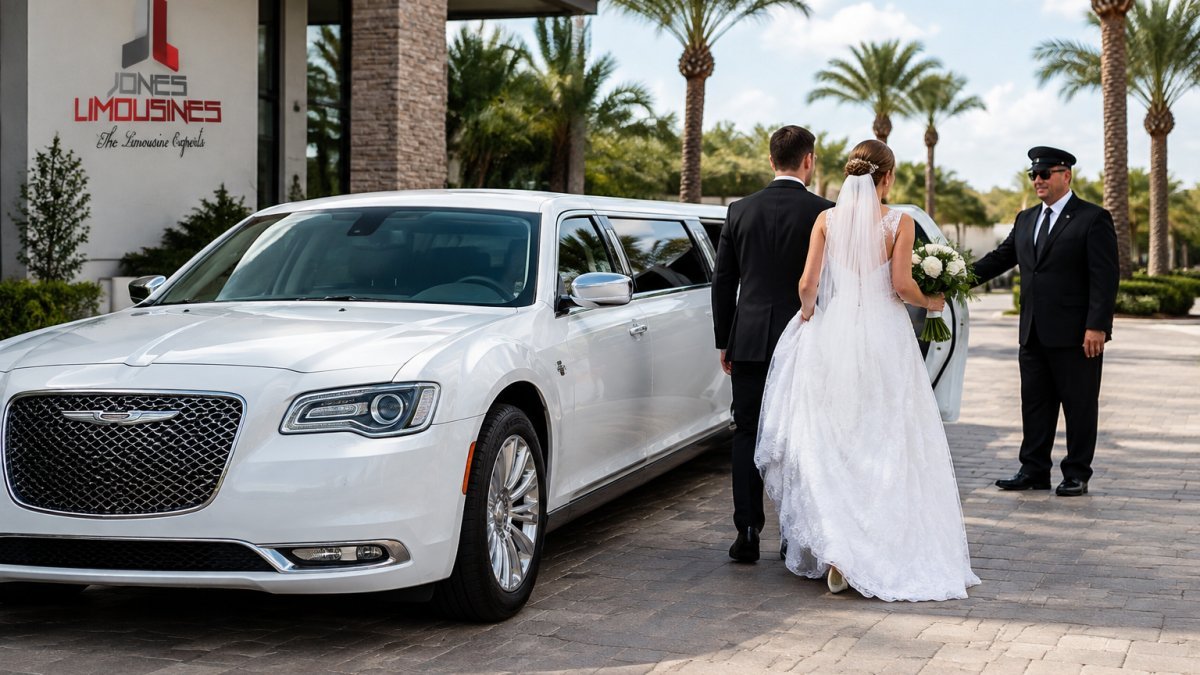
Chauffeur standing by a white stretch limousine for a wedding limo arrival at a scenic venue driveway.
Why a range? A hotel porte-cochere loads fast; a beach access point with one narrow lane and no turnaround eats ten minutes before anyone boards.
The buffer also covers the unexpected: a driver arriving at 2:55 for a 3:00 pickup and finding the street blocked by a delivery truck.
Arrival Buffer by Trip Type
A single 15-to-30-minute rule is a starting point, not a schedule. The buffer should change with what the trip has to accomplish. Use these ranges as a general guide, then adjust for the factors in the next section.
|
Trip type |
Recommended arrival before pickup |
Why |
|---|---|---|
|
Getting-ready location to ceremony venue |
20 to 30 minutes |
Loading a full bridal party, dress and train management, and a fixed ceremony start |
|
Hotel to ceremony venue (guests only) |
15 to 20 minutes |
Simpler loading, but hotel valet and porte-cochere congestion can add time |
|
Ceremony venue to reception venue |
20 to 30 minutes |
Post-ceremony photo run, guest greeting line, and a second loading point |
|
Reception departure / getaway car |
10 to 15 minutes |
Short loading window, but the car must be staged out of guest traffic |
|
Guest shuttle first run |
30 minutes |
First run sets the pattern; a late first run delays every later loop |
|
Multi-stop photo route |
30 to 45 minutes |
Each stop adds parking, staging, and re-boarding time |
Recommended arrival before pickup
The getting-ready location is where the dress, shoes, bouquet, and entire wedding party board at once, the slowest loading event of the day.
What the Buffer Actually Buys
The wedding limo arrival window of 15 to 30 minutes is not idle time. It covers four tasks before the first passenger opens a door:
- Positioning. The chauffeur finds the loading point, checks gate codes, and turns the vehicle so passengers board away from traffic.
- Check-in. The driver confirms the schedule with the planner and flags any route change.
- Staging. The vehicle is placed for photos if portraits are planned at the pickup.
Watch out: a buffer not written into the rental block is not a buffer. If your reservation and first pickup both start at 3:00 pm, the vehicle arrives with zero cushion. Ask your provider how their booking clock starts so the buffer is clearly part of the paid block.
When to Move to the Top of the Range
Take the 30-minute version, or more, when any of these are true:
- The ceremony start time is fixed and the officiant is on a tight schedule.
- The getting-ready location has no covered loading area or limited parking.
- The wedding party is larger than the vehicle’s comfortable seating count.
Take the 15-minute floor only when the pickup is a simple hotel porte-cochere, the drive is short and familiar, and the ceremony has slack. Most weddings do not meet all three.
Build a Wedding Transportation Schedule Template That Works
A wedding transportation schedule template is a single document listing every pickup time, location, vehicle, passenger group, and drop-off.
Fill it in once, share it with your planner and transportation provider, and update it as details lock.
Columns your template needs:
- Time (scheduled pickup, not departure)
- Vehicle and driver name
- Pickup location with a specific loading point
For a fuller walkthrough of how the pieces fit together, this step-by-step wedding party transportation logistics plan covers the full sequence from first pickup to final drop-off.
Sample Minute-by-Minute Wedding Limo Timeline
Here is how a typical afternoon schedule looks when the buffer rule is applied. Times assume a 4:00 pm ceremony.
|
Time |
What Happens |
Notes |
|---|---|---|
|
2:45 pm |
Limo arrives at getting-ready location |
15-minute buffer before pickup |
|
3:00 pm |
Bridal party boards |
Headcount confirmed by planner |
|
3:05 pm |
Vehicle departs for ceremony venue |
Travel time built in |
|
3:25 pm |
Arrival at ceremony venue |
35 minutes before ceremony |
|
3:30 pm |
Photos before guests arrive |
Venue access confirmed |
|
3:55 pm |
Ceremony party staged |
Planner cues processional |
|
4:00 pm |
Ceremony begins |
On time |
|
4:45 pm |
Vehicle repositions to reception venue |
Route checked in advance |
|
5:15 pm |
Guest shuttle first run |
If applicable |
That timeline works because every row has slack.
Factors That Change Your Arrival Buffer
Not every wedding needs the same cushion. Five variables move the number up or down.
Distance and route. A ten-minute drive on a known road needs less buffer than a forty-minute run across the bay.
Venue access. Churches with single-lane drop-offs, beach venues with soft sand, and downtown hotels with valet congestion all add loading time.
Guest count and vehicle capacity. Fourteen people in the wedding party may need two vehicles or one large one. More vehicles means more coordination at each pickup point.
Season. Peak wedding season means more cars on the road and more competition for venue loading zones.
Our full wedding car service planning guide breaks down how venue, guest count, and timing interact, which is worth reading before you finalize buffers.
Understanding Wedding Limo Rental Hours and Booking Lead Time
Wedding limo rental hours are the block of time you reserve the vehicle and chauffeur, usually sold in hourly increments with a minimum.
The two connect directly. A tight arrival buffer often means fewer package hours, because the vehicle is not sitting idle waiting for a slipped schedule. A generous buffer may push you into the next hourly tier.
How to think about rental hours:
- Count from first pickup to final drop-off, not from the ceremony
- Add the arrival buffer to the front of the block
- Add repositioning time between venues
That last point matters. Ask for the full breakdown in writing before you sign.
When you are ready to move from planning to reserving, this guide to booking wedding transportation walks through lead time and rental hours in detail.
Wedding Limo Driver Instructions to Share Before the Day
Driver instructions are the written notes you send your transportation provider at least a week before the wedding. They prevent the small confusions that snowball into late arrivals.
Send these in one message, not five:
- Exact pickup addresses with gate codes and loading zone names
- A named point of contact with a phone number, plus a backup
- The full schedule with buffer times marked
One thing most couples forget: tell the driver what the vehicle should look like when it pulls up.
It also helps to know what your package covers so your expectations match reality. This breakdown of what is included in a standard limo rental package is a useful checklist to compare against your confirmation.
Day-Of Coordination: Keeping the Schedule on Track
Day-of coordination means one person owns the transportation schedule in real time. Without it, the schedule is a wish; with it, a plan.
That person is usually the planner or a designated family member. Their job is simple: confirm each pickup five minutes before it happens and text the driver if anything shifts.
Who Owns What
A schedule survives the day only when each job has one name attached. Split the work like this:
- Transportation point of contact. One person, named in writing to the provider, who holds the driver’s number and the full schedule. This is the only person who calls the driver with changes.
- Backup contact. A second name and number in case the first is in hair and makeup or has no signal.
- Planner or day-of coordinator. Owns the master timeline and decides when a delay is serious enough to change the schedule.
One group chat with the planner, driver, point of contact, and backup is the simplest tool. Keep it to those people, a chat with twenty guests is noise, not coordination.
The Check-In Cadence
Good coordination is a rhythm, not a series of emergencies. A workable cadence:
- Night before: Point of contact sends the final schedule and confirms the driver’s name, vehicle, and phone number.
- 30 minutes before first pickup: Driver confirms location and any access issues.
- 5 minutes before each pickup: Point of contact confirms the party is ready or flags a delay.
That cadence catches most problems before they become late entrances.
Contingency Decision Points
Contingency planning is where most schedules fail. Decide these answers before the day, not during it.
If the limo is late: The point of contact calls the driver first, not the venue.
If a guest shuttle is delayed: The first run sets the pattern for every later loop.
If the schedule slips badly: The planner picks one of two options: compress the photo route or cut a stop. Decide which stop is expendable in advance so no one is negotiating it in a parking lot.
Watch out: the couple should not be the point of contact.
The exit matters too. These luxury wedding getaway car options are worth reviewing while you are mapping the end of the night.
Request a Quote and Lock In Your Wedding Limo Timing
Timing is the part of wedding transportation couples can actually control.
Start with the 15-to-30-minute rule. Build the template. Send clear instructions.
At J.L. Jones Limousines LLC, we have served the Tampa, St. Petersburg, and Clearwater area since 1995.
Get started with J.L.
A wedding day schedule has a lot of moving parts, and transportation is the one most couples leave to the last minute.
Frequently Asked Questions
How early should a limo arrive for a wedding?
Most transportation providers aim to have the vehicle on site 15 to 30 minutes before the scheduled pickup. That window lets the chauffeur confirm the address, park legally, and load the wedding party without rushing. If your getting-ready location has limited parking access or a long driveway, ask for the earlier end of that range. Confirm the planned arrival time in writing when you book so there is no confusion on the day.
How long should you schedule a wedding limo for?
Work backward from your ceremony start time and add travel time between every stop: getting-ready location, ceremony venue, photo location, and reception venue. Build in a 15 to 30 minute arrival buffer at each pickup and 10 to 15 minutes of contingency time for traffic conditions. Then add extra hours if you want the limo for the getaway after the reception. Share your full itinerary with the provider so they can recommend the right wedding limo rental hours.
How do you coordinate limo arrivals with the ceremony start time?
Set the ceremony start time as your anchor and count backward. Guests should be seated 15 to 20 minutes before the ceremony, the wedding party should arrive 30 minutes ahead, and the couple typically arrives 15 to 20 minutes before the aisle entrance for photos. Add travel time plus a buffer for each leg. Give your chauffeur a written timeline with named pickup and drop-off locations, and assign one point of contact to handle calls on the day.
What information should you give your wedding limo company?
Provide the full day-of timeline, every pickup and drop-off address, guest headcount for shuttle runs, and the name and phone number of a day-of contact. Note any access details like gate codes, loading zones, or parking restrictions at each venue. Mention photo stops and how long you expect them to take. Clear driver instructions reduce the chance of a late arrival and keep the wedding-day schedule on track from the first pickup.
