
Last Updated: November 4, 2026
Quick Summary
Real-time tracking lets attendees and dispatchers see where a shuttle is right now, so waiting is calmer and routes can be adjusted quickly. It also gives accurate arrival estimates, helps coordinate pickup zones, and produces data for planning future events.
- Share the live map with attendees, not just dispatch, to cut down on “where’s my ride?” calls.
- Build a small buffer into schedules: a 22-minute average loop should be published as a 25-minute cycle.
- Track load as well as location so dispatchers can send extra vehicles before a pickup line forms.
- Prepare a disruption playbook with alternate routes and an escalation threshold, such as a ten-minute delay.
Table of Contents
- How Real-Time Shuttle Tracking Works
- Benefit 1: Live Location Visibility for Attendees and Dispatchers
- Benefit 2: Accurate Arrival Times That Cut Wait Times
- Benefit 3: Smarter Event Shuttle Pickup Coordination
- Benefit 4: Faster Response When Traffic or Routes Change
- Benefit 5: Event Transportation Planning Built on Live Data
- Choosing an Event Shuttle Tracking App: Features and Privacy Limits
- Booking Shuttle Service for Your Next Event
- Frequently Asked Questions
How Real-Time Shuttle Tracking Works
Real-time tracking uses GPS hardware in a shuttle or limousine to send the vehicle’s position to a dispatch system. Attendees and organizers can then see that position on a map. Many systems also calculate an estimated arrival time based on current speed and traffic. For event transportation, this live data replaces guesswork with information you can act on.
The process works in three parts. A GPS unit on the vehicle reports location. A cloud platform receives and processes that data. A mobile app or web page displays it to the people who need it.
Many event organizers find the biggest value of real-time tracking is simply knowing where the shuttle is. Here is what a typical setup gives you:
- Live vehicle position on a map
- Arrival estimates for each pickup point
- Automatic alerts when a shuttle is delayed or rerouted
- A dispatch view of the whole fleet
Benefit 1: Live Location Visibility for Attendees and Dispatchers
Live location visibility gives two groups an answer to the same question: where is the shuttle right now? Attendees waiting at a curb want to know whether to keep waiting or walk back inside. Dispatchers want to see which vehicles are free, which are full, and which are running late.
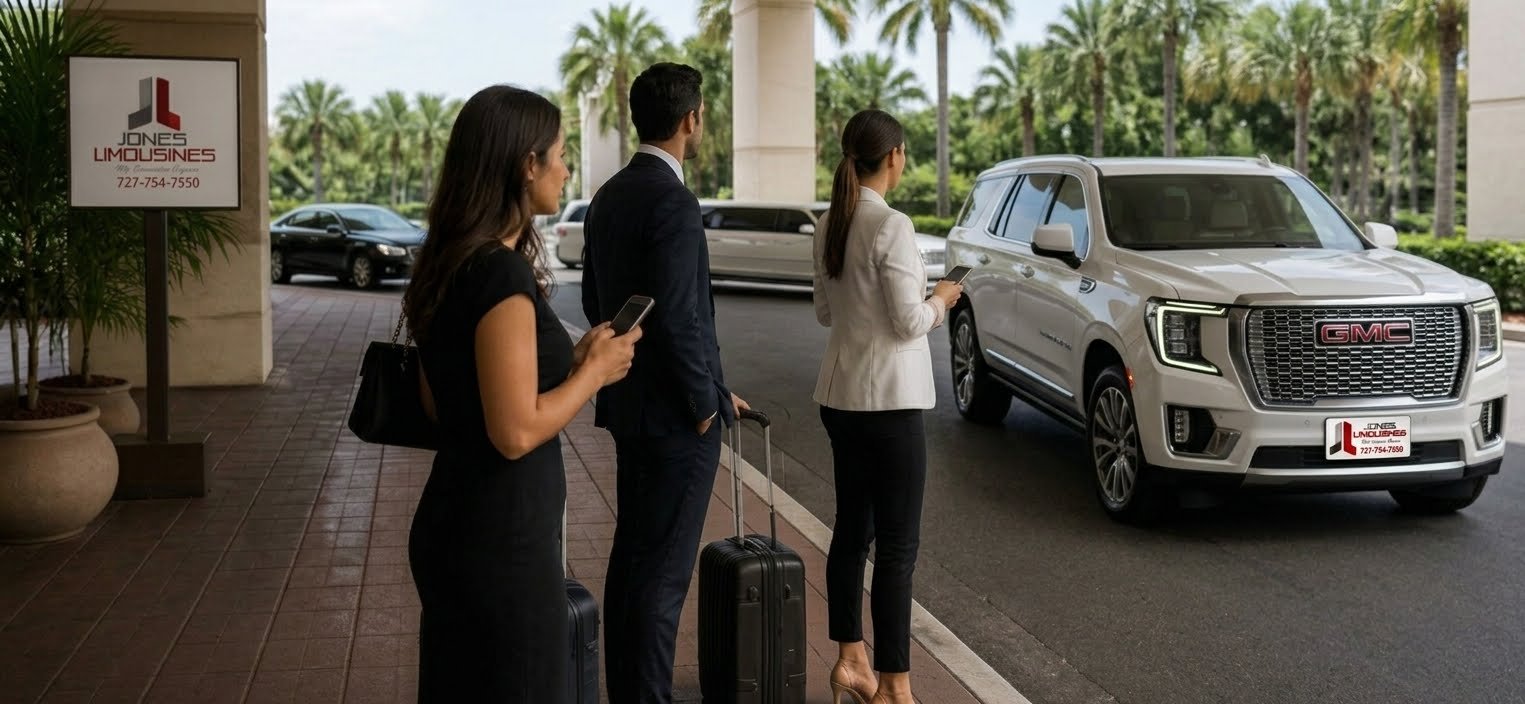
Attendees checking phones at a curbside pickup point as a SUV approaches using real-time tracking.
A common mistake is sharing the tracking link only with dispatch. Attendees generate most of the questions at a busy event, so giving them a simple public map, or a text link sent at boarding, cuts down on staff time spent answering “where’s my ride?” calls.
Plan your pickup zones so the map makes sense to a first-time visitor. Label each stop clearly and keep the names consistent between the app, the signage, and your printed materials.
Benefit 2: Accurate Arrival Times That Cut Wait Times
Accurate arrival estimates matter more than the vehicle’s exact position. An attendee who knows the shuttle is eight minutes out will wait calmly. One who sees no information will often walk, call, or crowd the curb.
Estimates improve when the system uses live traffic and recent travel times along your route, not a fixed schedule. Ask any provider how the arrival time is calculated before you commit.
Build a small buffer into your published schedule. If your average loop takes 22 minutes, tell attendees to expect a 25-minute cycle. Missing an estimate by a few minutes frustrates people less than a shuttle arriving early and leaving passengers behind.
The article points to a few concrete figures that help set attendee expectations for arrival times.
|
Scheduling item |
Example in the article |
Note |
|---|---|---|
|
Average loop time |
22 minutes |
Base the schedule on real travel time |
|
Published cycle time |
25 minutes |
Build in a small buffer |
|
Estimate window |
Within 5 minutes |
Early or late arrivals should stay close |
|
Attendee wait cue |
Shuttle eight minutes out |
Clear estimates keep waiting calm |
Benefit 3: Smarter Event Shuttle Pickup Coordination
Event shuttle pickup coordination depends on matching vehicle capacity to the flow of people at each stop. Real-time data lets dispatchers see when a stop is filling faster than expected and send an extra vehicle before a line forms.
Look for a system that shows load, not just location. Knowing a shuttle has 4 open seats is more useful than knowing it is somewhere on the highway. This matters most at the end of a concert or game, when departures bunch together and the pickup zone can become unsafe.
Assign one coordinator per pickup zone when possible. That person watches the live map, radios drivers, and keeps the queue orderly. The tracking data does the monitoring so your staff can focus on people.
Benefit 4: Faster Response When Traffic or Routes Change
Traffic, road closures, weather, and crowd-control barriers can break a planned route in minutes. Live tracking can show a problem as it happens, so dispatch can reroute vehicles before passengers notice a delay. The event-specific challenge is that disruptions rarely hit one shuttle in isolation: a blocked pickup zone or a late vehicle cascades into staggered departures, crowded curbs, and missed connections across multiple stops.
Build a short disruption playbook before event day and store it where dispatch can reach it. A workable version covers four scenarios:
- Traffic or closure: pre-identify two alternate routes to each pickup zone and confirm drivers have them in the dispatch system. When a delay alert fires, switch the affected vehicle and notify attendees at the next stop with a revised estimate.
- Vehicle breakdown: know which nearby vehicle can absorb the route and how long a replacement takes to arrive. Live location tells dispatch which shuttle is closest with open seats.
- Severe weather: decide in advance whether to pause, consolidate stops, or move to an indoor pickup point, and use the tracking app to push the change to everyone waiting.
- Sudden schedule change: if an event ends early or late, use live load and location data to rebalance vehicles toward the zones filling fastest rather than running the original loop.
Decide the escalation threshold in advance, such as a delay over ten minutes at any stop triggering a reroute review.
Accessibility belongs in the playbook, not as an afterthought. If a stop moves, send the new location through a channel attendees can read easily, including large-text messages and an option to receive updates by phone call for those who cannot use an app. Confirm the alternate stop is reachable for attendees with mobility needs before you publish it.
Watch out: rerouting without updating the published estimate creates more confusion than the original delay. Push the new arrival time at the same moment you move the vehicle.
Finally, plan for the tracking system itself to fail. GPS can drift in dense downtown areas, and signal can drop in parking structures or rural stretches. Keep printed schedules, staff radios, and a phone-tree fallback so the event still runs if the app goes down.
Benefit 5: Event Transportation Planning Built on Live Data
Post-event data can turn guesswork into a repeatable plan. After several events, organizers can review which pickup zones peaked, which hours needed extra vehicles, and where delays clustered. That history lets you set vehicle counts and schedules for the next event with more confidence than a pre-event estimate allows.
The gap most organizers leave open is measurement. Tracking software produces raw location pings, but a plan improves only when you convert those pings into a small set of event-shuttle KPIs. A practical scorecard includes:
- On-time arrival rate: the share of scheduled pickups where the shuttle arrived within your published window (for example, within five minutes of the estimate).
- Average wait time by stop: total attendee wait minutes divided by boardings at each pickup zone.
- Shuttle utilization: passenger boardings per vehicle-hour, which shows whether you over- or under-supplied capacity.
- Missed pickups: stops where a scheduled shuttle did not arrive or left passengers behind.
- Time to resolve a disruption: minutes from a delay alert to a confirmed reroute or added vehicle.
- Estimate accuracy: the share of arrival estimates that landed within five minutes of actual arrival.
Review the numbers within a week of each event while staff still remember the causes behind outliers.
Use the results to adjust the next plan in specific ways. If utilization is low on a midday loop but high at close, shift vehicles rather than adding them. If missed pickups cluster at one zone, revisit its location and signage before changing the schedule. If time-to-resolve is long, the problem is usually dispatch staffing or radio protocol, not the tracking software.
Watch out: comparing raw wait times across events of different sizes misleads. Normalize by attendee count or boardings before you draw conclusions.
Keep the data useful without overcollecting. Most organizers need only location, timestamps, and boarding counts.
Choosing an Event Shuttle Tracking App: Features and Privacy Limits
Not every tracking app suits every event. Before you choose one, check these points:
- Update frequency: How often does the vehicle position refresh?
- Offline behavior: What happens when a vehicle loses signal in a parking structure or rural area?
- Public versus staff views: Can attendees see a limited map without staff login?
- Accessibility: Does the app work with screen readers and offer text or phone alternatives?
- Data retention: How long is location data kept, and who can access it?
Privacy deserves particular attention. Location data reveals where people are picked up and dropped off. Organizers should ask providers how they limit access to location data and how long it is kept, and get those answers in writing.
Tracking also has limits, since GPS signal can weaken in some environments (GPS Accuracy). Build a manual backup plan, such as printed schedules and staff radios, so the event still runs if the app fails.
Booking Shuttle Service for Your Next Event
Planning shuttle transport for an event involves more than picking a vehicle. Start with your attendee count, pickup locations, and timing, then ask providers how they handle live tracking and dispatch. At J.L. Jones Limousines LLC, we help event planners in the Tampa, St. Petersburg, and Clearwater area match vehicles to group size and schedule. Pricing depends on vehicle type, number of trips, dates, and service hours, so contact us through our website for a current quote tailored to your event.
Frequently Asked Questions
What does real-time tracking mean for an event shuttle?
Real-time tracking means the shuttle’s GPS position updates continuously so dispatchers and riders can see where the vehicle is at any moment. Instead of guessing when a shuttle will reach a stop, attendees see a live map and estimated arrival time. Planners can also watch the fleet as a whole, spot a vehicle running behind, and reassign routes before a backlog forms at pickup points. The practical result is fewer missed pickups and less time spent waiting in crowds.
Can guests track an event shuttle from their phones?
Yes, many shuttle tracking setups give guests a link or mobile app view showing the vehicle’s live location and estimated arrival at their stop. Planners should confirm that the tool shows only what riders need, such as vehicle position and arrival estimate, and that guest location data is not stored longer than necessary. Testing the link at the venue before doors open helps catch connectivity problems early.
How can shuttle tracking improve event pickup coordination?
Shuttle tracking lets staff at each pickup point see which vehicle is arriving next and how many minutes remain. Staff can direct attendees to the right loading zone and release groups in waves rather than all at once. When a shuttle is delayed, the coordinator can notify the pickup team and attendees immediately. This reduces crowding at curbs and keeps the loading schedule on track through the busiest hour of the event.
What are the benefits of real-time tracking for event shuttles?
Common benefits of event shuttle tracking include clearer communication with attendees and better records for planning future events. Organizers who review tracking data after an event can compare on-time performance across routes and adjust schedules for the next one. Tracking works best when combined with a clear pickup plan and staff who know how to read the live map.
Get started with J.L. Jones Limousines LLC to plan your next event transportation with confidence. Share your group size and schedule, and our team will recommend the right vehicles for your pickups.
