
Quick Summary
Airport travel logistics is the chain of steps that gets you from your door to your airplane seat, and planning it works best when you build the timeline backward from your departure time. Start with the flight time, add gate, security and bag-drop windows, then add a drive buffer so you know exactly when to leave home.
- Arrive about two hours before domestic flights and three hours before international ones, confirming with your airline.
- Allow 30 to 45 minutes for gate time, 30 to 60 minutes for security and 30 minutes for bag drop.
- Add a 15 to 30 minute traffic buffer, and add 30 minutes to security on holidays and busy Mondays.
- Confirm pickup address, time, flight number and driver contact at least 24 hours before your ride.
- Pack light with a carry-on, keep medication and chargers in it, and turn on airline flight alerts.
Table of Contents
- Why Airport Travel Logistics Cause Stress (and How to Fix It)
- Step 1: Build a Door-to-Door Timeline Backward From Your Flight
- Step 2: Choose Your Airport Transportation and Confirm Pickup Details
- Step 3: Pack Light and Use a Reusable Airport Travel Checklist
- Step 4: Plan Contingencies for Flight Delays and Missed Connections
- Accounting for Families, Mobility Needs and International Travel
- Booking Your Airport Transfer Before Your Next Trip
- Frequently Asked Questions
Why Airport Travel Logistics Cause Stress (and How to Fix It)
Last Updated: November 5, 2026
Most airport stress does not come from the flight. It comes from the hours before it: a late ride, a missed check-in window, a bag that will not fit, or a traffic jam on the way to the terminal. Travelers in the Tampa Bay area often face these moments, and the pattern is almost always the same. A little planning around the ride, check-in, and bags can keep those last-minute problems from piling up and make timely arrival for cruises less stressful.
Airport travel logistics is simply the chain of steps that gets you from your door to your seat. Each link has its own timing, cost and risk. When one link breaks, the rest of the chain feels rushed.
Here is what usually causes the trouble:
- Arriving at the airport with no buffer for security or check-in lines
- Booking transport at the last minute and paying premium rates
- Packing more than one carry-on can handle
- Forgetting to confirm pickup times and meeting points
- Having no backup plan for delays or missed connections
The good news is that every one of these problems has a simple fix. The steps below walk through a plan you can reuse on any trip.
Step 1: Build a Door-to-Door Timeline Backward From Your Flight
Start with the departure time printed on your boarding pass, then work backward.
A workable backward timeline for a domestic flight looks like this:
- Flight departure: the time on your ticket
- Boarding and gate time: 30 to 45 minutes before departure
- Security screening: 30 to 60 minutes, depending on the day and hour
- Check-in or bag drop: 30 minutes if you have luggage
- Drive or transfer time: add a traffic buffer of 15 to 30 minutes
- Wake-up and getting ready: build in a realistic window
Write the times down. A simple list on your phone works fine. The goal is to see exactly when you must leave the house, not when you hope to leave it.
Worked example. Suppose your flight departs at 8:00 a.m. on a Tuesday and you are checking a bag. Boarding closes around 7:30 a.m., so you want to be through security by 7:15 a.m.
How to set the buffers. Treat each buffer as insurance, not padding. A 15-minute traffic buffer covers normal congestion; a 30-minute buffer covers rush hour, a major event, or a route with construction.
The night-before check. Confirm three things the evening before: the flight status in your airline’s app, the security wait time if your airport publishes one, and the pickup time with your driver. Airlines can change check-in rules, and some airports run longer security lines on holidays and Monday mornings. A 60-second check the night before is cheaper than a missed flight.
Watch out: if your timeline has no slack between the drive and the bag-drop cutoff, one red light or one slow security lane turns a comfortable trip into a sprint.
Here is the domestic timeline from the article, working backward from departure.
|
Stage |
Time or buffer |
Note |
|---|---|---|
|
Boarding and gate time |
30 to 45 minutes before departure |
Before the flight leaves |
|
Security screening |
30 to 60 minutes |
Varies by airport and day |
|
Check-in or bag drop |
30 minutes |
If you have luggage |
|
Drive or transfer time |
15 to 30 minutes buffer |
Covers traffic |
|
Airport arrival (domestic) |
About 2 hours before flight |
Confirm with your airline |
|
Airport arrival (international) |
About 3 hours before flight |
Confirm with your airline |
Step 2: Choose Your Airport Transportation and Confirm Pickup Details
Transportation is the link most travelers underestimate, and it is the one place where the right choice depends on your trip rather than on a single “best” option. Compare the five common ways to reach the airport on four criteria: cost, reliability, convenience, and luggage capacity.
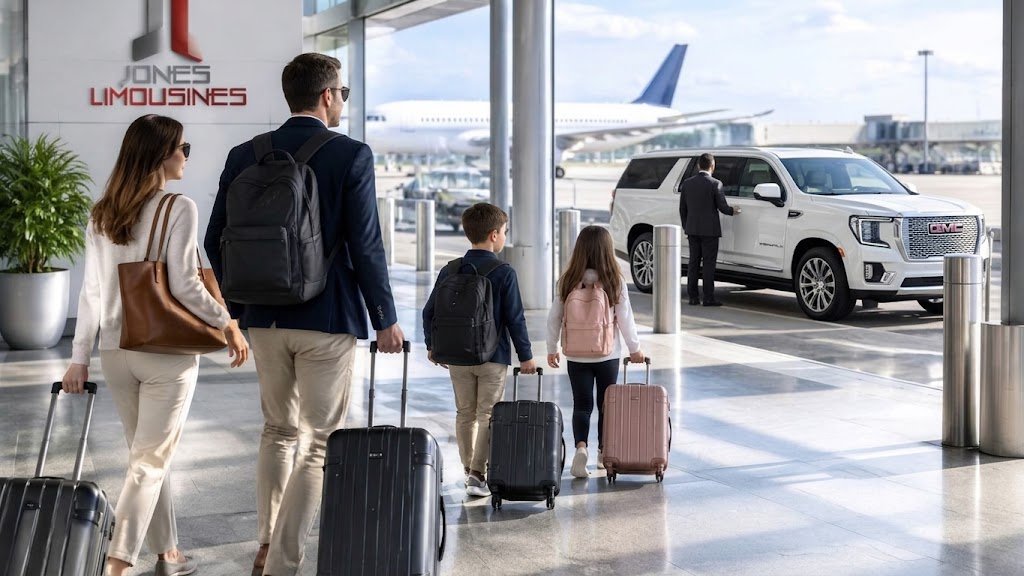
A professional chauffeur greeting a couple with luggage to streamline airport travel logistics at the terminal curb.
- Airport parking. Best for travelers who want their own car at the other end of the trip. On-airport garages are the most convenient but usually the most expensive per day; off-airport lots cost less but add a shuttle ride of 10 to 20 minutes each way. Reserve a spot in advance on busy travel dates, and note that the daily rate often changes with the length of stay.
- Rideshare. Convenient and often cheap at off-peak hours, but surge pricing and driver availability can change quickly during rush hour, bad weather, and early-morning departures. Schedule the ride in advance if the app allows it, and have a backup in mind.
- Taxi. Metered or flat-rate depending on the market, with the advantage of curbside availability. Confirm whether the fare is fixed before you get in, and check that the vehicle can hold your luggage.
- Public transit. The lowest-cost option where it exists, but it is the least forgiving of delays and the hardest with heavy bags. Use it only when you have a generous buffer and a simple route.
- Drop-off by a friend or family member. Free and familiar, but it depends on someone else’s schedule and on the drop-off lane being open. Confirm the terminal and the curb in advance.
A pre-booked car service sits between rideshare and taxi: you can arrange a confirmed pickup time in advance, which reduces availability uncertainty. You can also compare corporate airport shuttle alternatives in Tampa before you decide. To see whether it fits your budget, review a cost and convenience breakdown of private car service.
Once you choose a provider, confirm the details at least 24 hours before pickup:
- Pickup address and exact meeting point
- Pickup time, with a clear window
- Flight number so the driver can track arrival changes
- Driver contact information
- Number of passengers and bags
We recommend sending your flight number with your booking. That way, if your plane lands early or late, the pickup can adjust without a scramble. For airport transfers in the Tampa area, we serve Tampa International Airport (TPA) and St. Petersburg-Clearwater International Airport (PIE).
Watch out: do not assume a driver will know your terminal or that the drop-off curb will be open. Confirm the terminal and the arrivals or departures curb in advance, and keep the driver’s number saved in your phone.
Step 3: Pack Light and Use a Reusable Airport Travel Checklist
Packing light cuts both stress and cost. Many airlines charge for checked bags, and waiting at baggage claim adds time you may not have. A carry-on that fits your airline’s size limits lets you move through the airport faster.
Use a checklist you can copy and reuse for every trip:
- Government-issued photo ID or passport
- Boarding passes saved on your phone and printed backup
- Travel documents, visas or entry forms if needed
- Chargers, power bank and headphones
- Medications in their original labeled containers
- Comfortable clothes and one change of clothes in your carry-on
- Liquids under the size limit in a clear bag
- Snacks and a refillable water bottle (empty before security)
- Printed hotel and pickup confirmations
Keep your most important items in your carry-on. That includes medication, chargers and any documents you may need if checked luggage is delayed. Organize the bag in packing cubes or pouches so you can find items fast at security.
Step 4: Plan Contingencies for Flight Delays and Missed Connections
Even well-planned trips face delays. The best defense is a backup plan you have already thought through.
Start by checking your flight status before you leave for the airport. Turn on flight alerts in your airline app. If your flight is delayed, you can often rebook from your phone before you reach the terminal.
Next, plan for these common situations:
- Late arrival of your flight: Ask your driver to track the flight and adjust the pickup window.
- Missed connection: Look for a later flight on the airline app before you stand in the rebooking line.
- Lost or delayed bags: Keep your baggage claim tag and a list of bag contents in your phone.
- Long security lines: Build in extra time on busy travel days.
A practical rule is to add a 30-minute buffer to your timeline for every connection and an extra hour on peak travel days. For more ways to avoid costly parking, see smart strategies for avoiding airport parking. This buffer costs very little and can save an entire trip.
Accounting for Families, Mobility Needs and International Travel
Not every trip follows the same plan. Families, travelers with mobility needs and international passengers each face extra steps.
Families with children:
- Bring snacks, a change of clothes and entertainment for young travelers
- Ask for a larger vehicle or extra seat space when booking
- Add 30 more minutes to your timeline for security and bathroom stops
Travelers with mobility needs:
- Request wheelchair assistance from your airline at least 48 hours in advance
- Confirm that your transport vehicle can accommodate your equipment
- Ask your driver about the easiest curb for drop-off or pickup
International travelers:
- Check passport validity rules for your destination country
- Allow extra time for customs and immigration at arrival
- Confirm your ground transportation at the destination in advance
Many travelers find that a little extra planning at this stage prevents the most stressful moments of the trip.
Booking Your Airport Transfer Before Your Next Trip
Good airport travel logistics come down to three habits: plan backward from your flight, confirm every ride detail in advance and keep a simple backup plan ready. Pricing for airport transfers depends on the vehicle, the date, the time of day and the number of passengers, so the best way to get an accurate figure is to ask for a quote.
For a reliable ride to or from Tampa International Airport or St. Petersburg-Clearwater International Airport, visit the executive airport transportation service page from J.L. Jones Limousines LLC or call 727-754-7550 to ask about current rates and availability. Our team can help you choose the right vehicle and arrange a pickup time before your next trip.
Frequently Asked Questions
How early should I leave for the airport?
For a domestic flight, plan to arrive at the airport about two hours before departure, and allow three hours for international flights. Add time for your transport’s travel conditions, parking or pickup delays, and bag drop if you check luggage. Build the timeline backward from your departure time, then add a buffer of 15 to 30 minutes for unexpected slowdowns at the curb or security checkpoint.
What should I confirm with my airport transportation provider?
Confirm your pickup address, the exact terminal and curbside location, your flight number so the driver can track arrivals, and the number of passengers and bags. Ask for the driver’s contact number, the vehicle type, and the cancellation policy. Request a written confirmation with the total quoted price. Pricing depends on vehicle, date, distance and service level, so ask J.L. Jones Limousines LLC for a current quote on the website.
How can I plan for flight delays or changes?
Enable flight status alerts in your airline app, and check the status before you leave. Keep your booking confirmation and a backup plan, such as a second arrival time or a rebooked ride, in case your flight shifts. If your flight is delayed, notify your transport provider so the pickup can be adjusted instead of waiting at the curb. Keep phone chargers and essential medication in your carry-on.
What should I pack in my carry-on for an easier airport experience?
Pack medication, chargers, a change of clothes, headphones, and snacks in your carry-on, along with documents such as your boarding pass and ID. Keep liquids within the Transportation Security Administration (TSA) 3-1-1 rule of 3.4-ounce containers in a single quart-size bag. Using a carry-on alone can help you avoid checked-bag delays, and packing light makes security screening and terminal navigation simpler.
