
Last Updated: November 10, 2026
Quick Summary
A private airport transfer for families with car seats is a pre-booked, chauffeured ride where you request age-appropriate child restraints at booking and the seats are already fitted when you land. You confirm seat types and counts in writing, then inspect the installation at the curb before departure.
- Submit each child’s age and weight at booking so the provider can match the correct seat.
- Reserve vehicle and seats 2-4 weeks out, since seat inventory is limited on busy dates.
- Reconfirm seat count and types 24 hours before pickup to prevent a last-minute mismatch.
- A properly fitted booster should not move more than about one inch in any direction.
- Ask whether the seat fee is per seat or per booking before comparing quotes.
Table of Contents
- Why Families Book a Private Airport Transfer With Car Seats
- Airport Transportation With Car Seats: What to Expect From a Private Service
- How to Book a Private Car Service With Child Seat Requests
- Airport Pickup With Infant Car Seat: Matching the Seat to Your Child
- Airport Transfer With Booster Seat: Rules, Fit, and Installation Checks
- What Affects the Cost of a Family Airport Transfer
- Handling Flight Delays, Missed Seats, and Backup Plans
- Request Your Family Airport Transfer Quote
- Frequently Asked Questions
Why Families Book a Private Airport Transfer With Car Seats
A private airport transfer for families with car seats solves one of travel’s most stressful logistics problems: you land, you’re met, and an age-appropriate child restraint is already fitted in the vehicle.
Rideshare apps don’t reliably supply child seats, and rental counters mean installing a strange seat in a strange garage after a long flight.
Below, we’ll show you how to request seats, match the right restraint to each child, and check the installation before you leave the airport.
Airport Transportation With Car Seats: What to Expect From a Private Service
Airport transportation with car seats works differently from a standard sedan booking. You’re reserving a specific vehicle type, a specific number of restraints, and a chauffeur who arrives with the seats already installed and inspected.
A private airport transfer is a pre-booked, door-to-door ride in a chauffeured vehicle, with a fixed pickup time and confirmed seat configuration. The seats, vehicle, and driver are locked in before your flight lands.
Expect these steps in a typical private service:
- You submit seat requests at booking, including each child’s age and weight
- The provider confirms seat availability in writing
- The provider’s chauffeur meets you at arrivals
Seat Types and Availability
Private services vary in the restraint categories they carry, and availability should be confirmed, not assumed. Infant car seats suit newborns and smaller babies, typically rear-facing. Toddler seats, also rear-facing or forward-facing depending on the child, handle the next stage.
Ask three questions when you book: Which seat types do you carry? How many of each can you supply on my date? And who installs them? NHTSA’s child passenger safety guidance is the reference point for matching seat type to a child’s age and size, and it’s worth a look before you specify seats.
How to Book a Private Car Service With Child Seat Requests
Booking a private car service with child seat requests takes about ten minutes if you have the right details ready. Give the provider enough information to match seats to children on the first try.
Here’s a booking sequence to follow:
- Count passengers and list each child’s age and weight
- Note how many infant, toddler, and booster seats you need
- Confirm vehicle type and luggage capacity for your group
- Give flight number and arrival time, not just the date
- Request written confirmation of seat type and count
- Ask about the waiting-time policy for flight delays
For a step-by-step walkthrough of the booking process itself, see how to book an airport luxury car service.
Booking Checklist and Timeline
Book as early as your plans allow, and treat seat requests as the item most likely to sell out on peak dates, since seat inventory may be limited. Use this checklist and timeline:
|
When |
Action |
Why It Matters |
|---|---|---|
|
2-4 weeks out |
Reserve vehicle and seats |
Seat inventory is limited on busy dates |
|
1 week out |
Confirm flight details |
Catches schedule changes early |
|
24 hours out |
Reconfirm seat count and types |
Prevents a last-minute mismatch |
|
At pickup |
Inspect installation |
Catches fit problems before you drive |
If you’re planning a larger group, our guide on how far in advance to book group limousines covers timing in more detail.
Airport Pickup With Infant Car Seat: Matching the Seat to Your Child
Airport pickup with an infant car seat starts with one rule: the seat must match the child’s age, weight, and height, not just the label on the box.
Rear-facing seats are standard for infants and younger toddlers because they support the head and neck in a crash. Forward-facing harnessed seats suit older toddlers and preschoolers.
Give the provider your child’s weight and height at booking, since that detail helps match the correct seat.
Airport Transfer With Booster Seat: Rules, Fit, and Installation Checks
An airport transfer with booster seat arrangements should include an installation check before the vehicle moves. A booster only works if the lap belt sits low across the hips and the shoulder belt crosses the middle of the shoulder, never the neck.
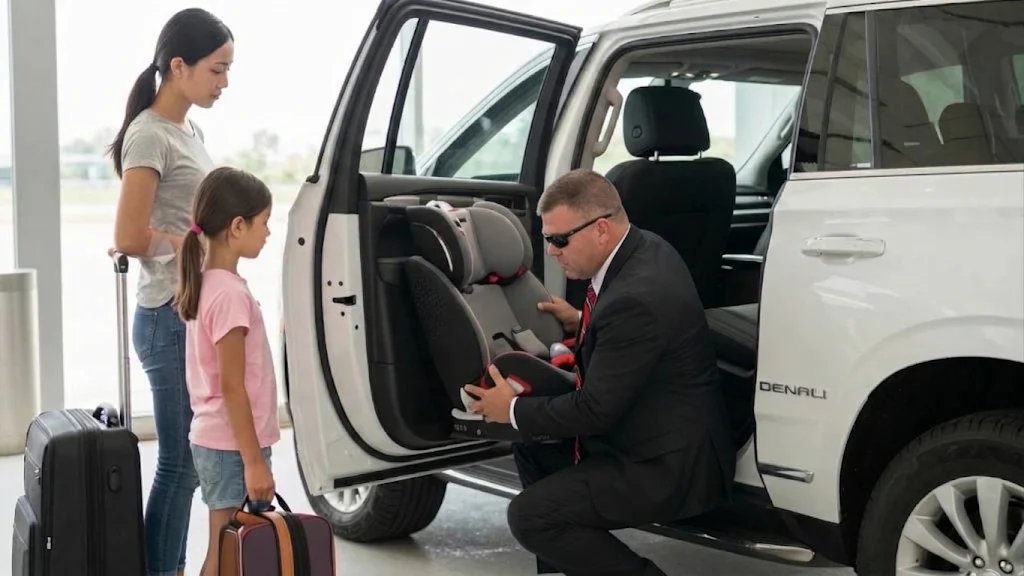
Chauffeur checking a booster seat during a private airport transfer for a family with luggage.
Who Installs the Seat
In a chauffeured transfer, the restraint may be installed by the driver before pickup rather than by you at the curb. Ask at booking who performs the install and whether that person has current child passenger safety training.
If you are bringing your own booster, tell the provider at booking and confirm their policy on installing parent-supplied seats before you fly.
How to Verify the Installation at Pickup
Run this check at the curb, with your child in the seat, before the driver pulls away. It takes about two minutes.
- Seat stability: grip the booster at the belt path and try to move it side to side and front to back. A properly fitted booster should not move more than about one inch in any direction.
- Lap belt placement: the lap portion should sit low and flat across the upper thighs or hips, not across the soft part of the stomach.
- Shoulder belt placement: the shoulder portion should cross the middle of the shoulder and chest, never the neck or face. If it rubs the neck, ask about a belt-positioning guide or height adjustment.
Watch out: a booster that looks correct in a photo can sit wrong in a specific vehicle seat, especially in an SUV’s third row where the cushion is shorter or the belt geometry differs. Check the fit in the actual vehicle.
When the Supplied Seat Is Wrong
Seat mix-ups happen, and the response matters more than the mistake. Before you travel, ask two questions: what is your process if the seat at pickup doesn’t match my request, and do you carry a spare of each seat type on family runs?
If the seat is the right type but the fit is wrong, don’t accept “it’s fine” from the driver. Ask for the seat to be reinstalled or moved to a different seating position.
Booster Rules to Know Before You Book
Booster laws vary by state, and the rules usually follow age, height, and weight rather than a single birthday (Child Passengers). NHTSA’s child passenger safety guidance is the reference point for matching seat type to a child’s size, and it is worth a look before you specify seats.
Give the provider your child’s height and weight at booking, not just age, since those details help match the correct booster and give you a written record if the seat at pickup does not match.
What Affects the Cost of a Family Airport Transfer
Family airport transfer pricing depends on vehicle size, seat count, distance, and timing. Pricing depends on quantity, dates, and delivery, so contact J.L. Jones Limousines LLC through its website for current prices or a quote. Larger vehicles and multiple restraints cost more than a standard sedan, and peak dates carry different rates. Knowing how each factor shows up on the invoice is what helps you compare two quotes.
The main cost factors, and how to read them on a quote:
- Vehicle type: SUVs and larger vehicles cost more than sedans because they carry more passengers and luggage. A family of four with two car seats and four checked bags usually needs an SUV or large sedan. Ask for the vehicle class in writing.
- Seat count: each requested restraint can add a fee. Ask whether the fee is per seat or per booking, and whether all seat types are priced the same.
- Distance and destination: airport charges and tolls vary by route. Ask whether the quote includes airport access fees, tolls, and any terminal pickup surcharge.
How to Compare Two Quotes
Ask every provider for an all-in quote listing seat fees, airport charges, tolls, gratuity policy, and waiting-time terms as separate lines.
Headline rates may exclude seat fees and airport charges, so compare the total cost of each quote.
Watch out: a quote that does not state the waiting-time window and the seat fee structure in writing is not a quote you can compare.
What to Confirm Before You Pay
- The total, itemized, in writing
- Whether gratuity is included or expected on top
- The cancellation and change policy, especially if your flight date may move
If you are weighing a transfer against driving yourself, our cost and convenience analysis breaks down the trade-offs, including parking, rental, and rideshare alternatives for a family with car seats.
Handling Flight Delays, Missed Seats, and Backup Plans
Flight delays and seat mix-ups are the two things most likely to derail a family airport transfer, and both are manageable with a plan set before you fly. Give the provider your flight number so they can track arrival changes, and confirm the waiting-time policy in writing.
Build a backup plan around three points:
- Delayed flight: confirm the provider tracks flight status and holds the vehicle
- Seat mismatch at pickup: know the provider’s process for swapping a seat
- Missed connection: have the provider’s contact number saved before you board
For a fuller framework on managing arrival logistics, read our guide to stress-free airport travel planning. And if you’re still deciding between parking and a transfer, these strategies to avoid airport parking cover the alternatives.
Request Your Family Airport Transfer Quote
The gap between a stressful arrival and a calm one usually comes down to preparation, not luck.
J.L. Jones Limousines LLC has served the Tampa, St. Petersburg, and Clearwater area since 1995, with a fleet of stretch limousines, SUVs, and sedans.
Contact J.L. Jones Limousines LLC through its website to request a quote.
Ready to lock in your family’s airport ride?
Frequently Asked Questions
Do airport transfers provide car seats?
Many private airport transfer companies keep infant, toddler, and booster seats on hand, but seats are usually provided on request rather than by default. Availability on request means you should state your child’s age, weight, and height when you book, and ask for written confirmation that the seat will be in the vehicle. If a provider cannot confirm a seat, plan to bring your own or choose a company that can.
What information should I give a car service when requesting child seats?
Give the age, weight, and height of each child, the number of children traveling, and whether you need rear-facing, forward-facing, or booster seats. Add your flight number, arrival time, pickup and drop-off addresses, and how much luggage and stroller equipment you carry. This lets the provider match the right seat type and send a vehicle with enough passenger and luggage capacity, and it puts the seat request in your booking details.
Can I bring my own car seat on a private airport transfer?
Yes. Bringing your own seat is often the safest choice because you know its history and how it installs. Tell the provider in advance so the chauffeur allows time for installation at pickup. Ask whether the vehicle has lower anchors or a lap-and-shoulder belt in the seating position you need, and confirm the seat will fit without blocking other passengers. Keep the seat with you on the flight rather than checking it.
What should I do if my flight is delayed or my car seat request is not confirmed?
Send your flight number when booking so the provider can track arrival and adjust pickup time, and confirm the waiting time included in your quote. If your seat request is not confirmed in writing, call before you fly and ask for a clear yes or no. As a backup, carry a lightweight booster or travel seat where legal for your child, and keep the provider’s phone number handy so you can update them from the tarmac.
